
By Steven Baltsas, Peggy N. Gerry Curatorial Fellow
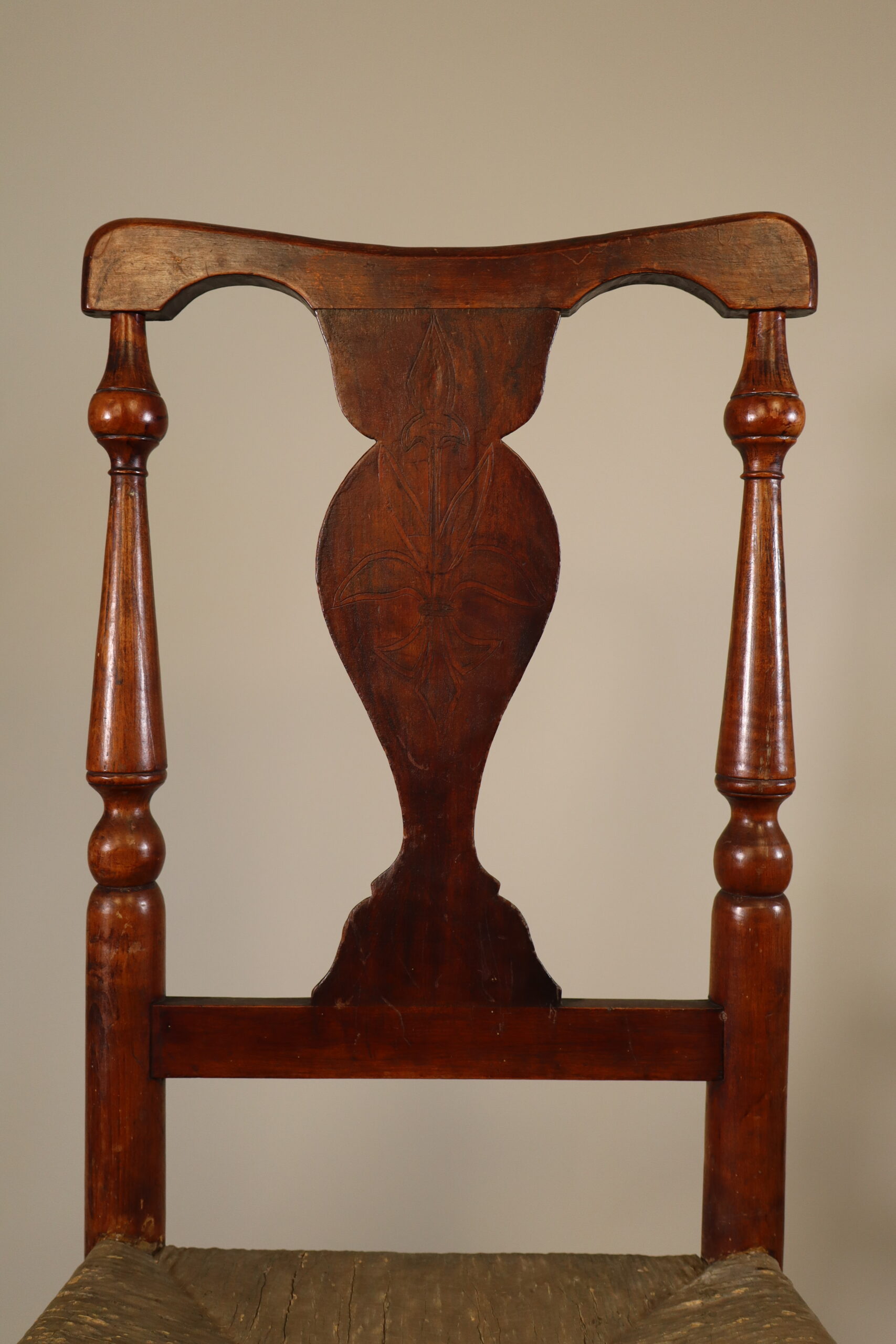
No one can explain why a chair in our collection bears a fleur-de-lis. Long associated with France, this faintly carved symbol might seem misplaced on a chair from Long Island. But three centuries ago, French artisans did belong to a multicultural woodworking community on the island’s westernmost end. Now the boroughs of Queens and Brooklyn, J. S. Huyler Held (1902–1952) speculated this chair form might’ve developed here. He referred to the chairs as Dutch splat backs; others call them York chairs.
Winabeth Woodworth, Held’s widow, noted the fleur-de-lis chair once belonged to a “Daniel Bearde [sic].” That figure might’ve been Daniel Carter Beard (1850–1941) of Flushing, Queens: a prolific illustrator and early proponent of the Boy Scouts of America, whose emblem is a fleur-de-lis. Could Beard’s background explain the presence of this motif on an otherwise ordinary chair?
Before Beard, Long Islanders modified their furniture in great numbers. During the 1820s and 30s, scores of homeowners had their older chairs updated with black and gold paint to match contemporary aesthetics. Others continuously rewove their seat bottoms with saltwater rush or caning, replacing the surfaces worn by daily use. In the twentieth century, collectors of furniture sometimes added embellishments to make modest pieces appear more spectacular. The myriad alterations to Long Island furniture tell us about life overtime. Even if we’ll never know who carved the fleur-de-lis or when, it is part of the chair’s life story.
Launching the Long Island Furniture Project
This complicated scenario typifies the work I’ve been faced with for the Long Island Furniture Project. A multi-format initiative, this project will increase knowledge and accessibility to furniture made on Long Island, ca. 1660–1860. Bringing these objects to light, we hope to engage the public, spark an interest in historic furnishings, and prompt further research into the Island’s furniture-making traditions.
Though the study of Long Island furniture is not without its challenges, the interactions it encourages are valuable. In six months of fieldwork, community members and colleagues have led us to barns, attics, basements, and other spaces to see the furniture they care for. A simple question: “how long has this chest been here?” can generate a conversation about who might’ve made or used the piece locally. The objects we’ve seen in their original context ask us to consider how they’ve survived in a region wrought by irreversible changes.
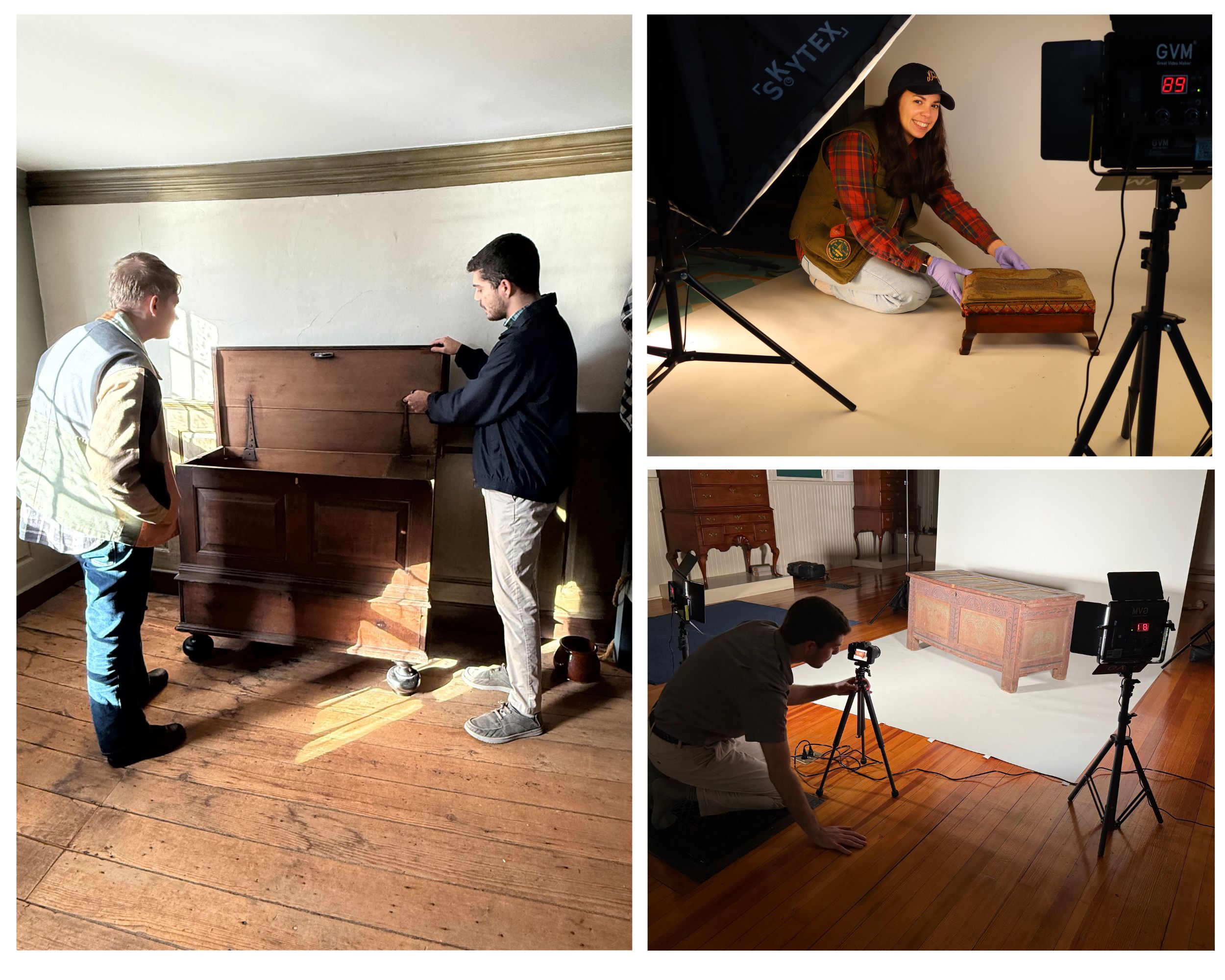

Over the next year, we’ll be embarking on fieldwork across Long Island, cataloging extant furniture in public and private collections. Each piece of furniture logged will appear in our forthcoming digital database of Long Island furniture. Entries will offer multiple photos of objects alongside details such as materials and physical dimensions. For those who don’t live on Long Island, the expense of traveling here for research can often be prohibitive. Recognizing this challenge, we’re committed to an open-access database format, which will enable scholars, cultural heritage workers, or furniture stewards to access these materials worldwide. The database promises to be the first of its kind launched in the Mid-Atlantic.
The Long Island Furniture Project’s research continues the scholarship of former Preservation Long Island curator, Dean F. Failey (1947–2015). In summer 2026, we will celebrate the fiftieth anniversary of Failey’s landmark exhibition, Long Island Is My Nation: The Decorative Arts & Craftsmen, 1640–1830 by launching a companion exhibition to the Project. Just as Long Island Is My Nation commemorated America’s Bicentennial in 1976, our 2026 exhibition uses Long Island furniture to reflect on our nation’s history for the Semiquincentennial.
Case (Piece) Studies
Community and identity are essential themes for this Project. Examining furniture with this in mind, we can locate these themes in the work of Long Island’s furniture makers. So far, we’ve found that case pieces often yield the most information about the Island’s past. These pieces include chests of drawers, wardrobes, or sideboards—furnishings whose substantiality provides ample space for evidence. The first object we documented was a high chest of drawers made in northern Queens (now Nassau) County about 1740. An expanse of port villages, coastal Queens County had several robust cabinetmaking shops. Many of these makers and their patrons were Quakers, especially in the vicinity of Flushing and Westbury.
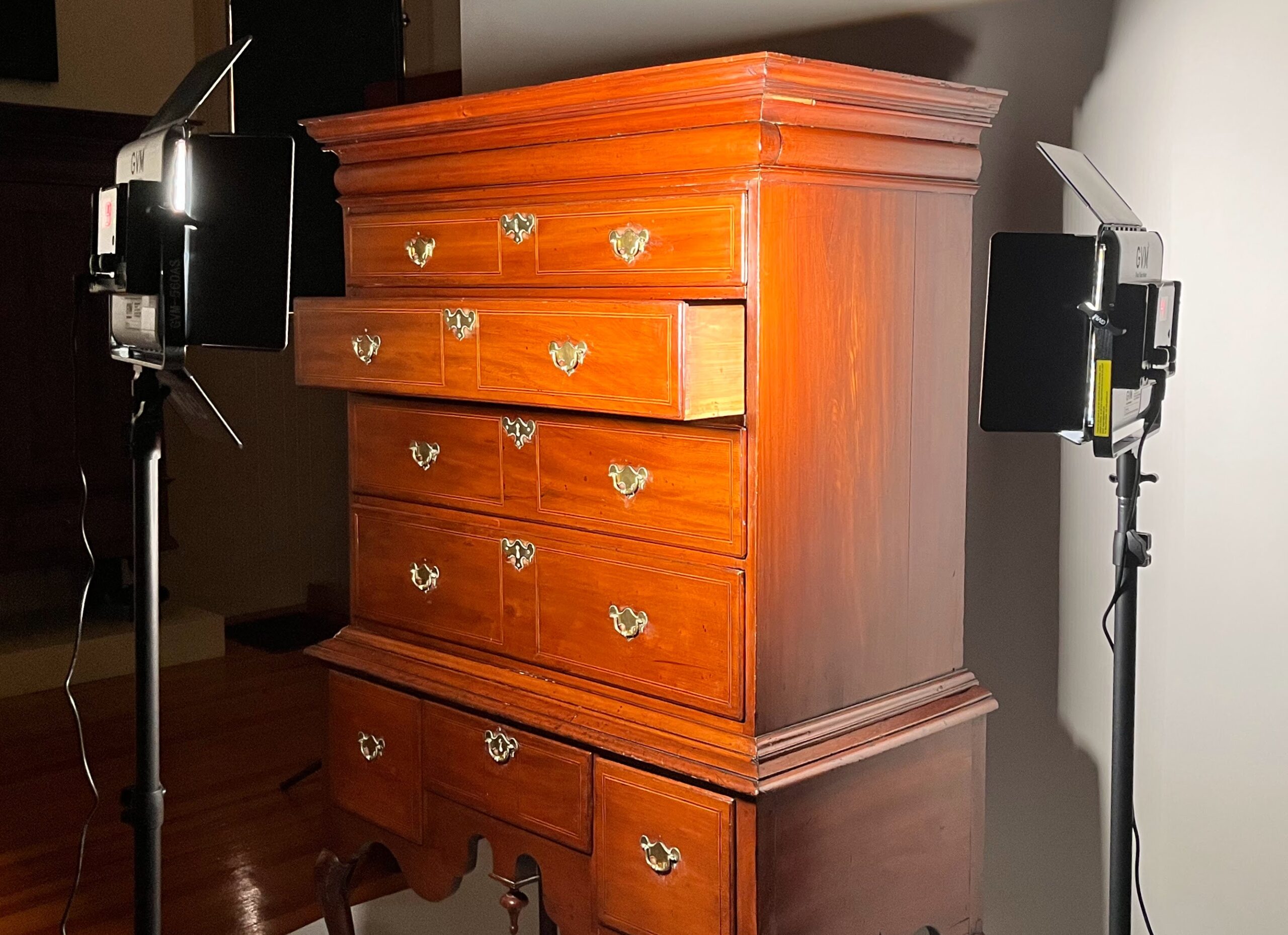
Based on the carved skirt of this high chest (left), we know that a Queens County furniture maker was evidently conscious of contemporary furniture design in New York City and Newport, Rhode Island. Boasting a large Quaker population, Newport was also a major center for the Atlantic slave trade. Ties in design between Newport and northern Queens County raise many questions about the role of labor and Quakerism in the county’s furniture. As in Newport, it is worth examining how enslaved laborers impacted furniture production. Forthcoming research will use Queens County high chests as evidence of the role that Long Island played in larger histories of the Atlantic World.
Specific furnishings held deep meanings for their owners that are not so challenging to discern and appreciate today. The Cooper family of Southampton spawned several woodworking men, including the carpenter and whale boat builder Caleb Cooper (1745–1834). In 1998, Preservation Long Island acquired two pieces of case furniture from Cooper’s great-great-granddaughter, Sag Harbor preservationist Nancy Boyd Willey (1902–1998). These included a vermillion-painted chest with the inscription “Mary Cooper – Southampton April 28th – 1809” written on the interior. Long thought to have been a bespoke wedding gift from Cooper to his daughter Mary Cooper Crooker (1788–1810), we are now re-evaluating this belief: Mary wed in 1803, not 1809, and never lived on Long Island again following her marriage. This chest is one of three Cooper family-made objects in our collection that the family marked with their name, conveying a commitment to their vocation and legacy over generations.

As we move further along, we look forward to sharing new developments and the Long Island furniture we encounter along the way. If you own furniture with a documented history of ownership on Long Island, especially pieces bearing makers’ marks or inscriptions, we invite you to share them with us. Scholars have often used the metaphor of a complex puzzle to describe the study of Long Island furniture. With your help, we can continue to complete this puzzle, and move towards an understanding of what it represents.
Preservation Long Island extends its gratitude to the Decorative Arts Trust, the Gerry Charitable Trust, and the Long Island Libraries Resources Council for making this project possible.
Further Reading
Lauren Brincat, “John Bowne’s Flushing: Material Life on the Dutch Frontier, 1645-1700” (Master’s thesis, University of Delaware, 2014).
Dean F. Failey, Long Island Is My Nation: The Decorative Arts & Craftsmen, 1640–1830 (Cold Spring Harbor, NY, 1976; reprint 1998).
Laini K. Farrare, “Blowin’ in the Wind: The Hidden Hands of East Hampton,” (Master’s thesis, University of Delaware, 2024).
Peter M. Kenny, Frances Gruber Stafford, Gilbert T. Vincent, American Kasten: The Dutch-Style Cupboards of New York and New Jersey, 1650–1800 (New York, NY, 1991).


